
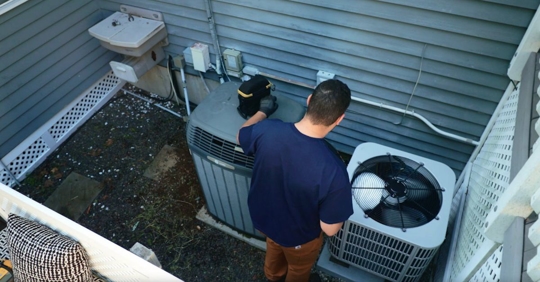
In 2025, the HVAC industry entered a new chapter, and you might not have noticed. If you’re planning to replace your air conditioner in 2026, the refrigerant inside it will likely be different from what it was just a few years ago.
After the phaseout of R-22 and widespread adoption of R-410A, the industry is now transitioning again. This time it’s moving to R-454B. Understandably, you might be asking, “Why another change? Is my current system still okay? Is the new refrigerant safe?”
This blog post addresses those questions, helping you understand the new refrigerant requirements and changes in the HVAC landscape.
Why Is R-410A Being Phased Down?
The shift away from R-410A is driven by federal environmental regulations under the EPA’s American Innovation and Manufacturing (AIM) Act. The goal is to reduce production and consumption of high-global-warming-potential (GWP) hydrofluorocarbons (HFCs) by 85% by 2036.
Unlike the R-22 transition, this change is not about ozone depletion. It’s about climate impact.
Here’s how the two refrigerants compare:
- R-410A – 100-year GWP of approximately 2,088
- R-454B – 100-year GWP of approximately 466
Switching to R-454B results in a significant reduction in greenhouse gas emissions.
Importantly, R-410A is not illegal, and you do not need to replace a functioning system. However, as of January 2025, newly manufactured residential air conditioning systems are transitioning to lower-GWP refrigerants, such as R-454B.
What Is R-454B?
R-454B is a next-generation refrigerant blend of R-32 and R-1234yf. It was selected by major HVAC manufacturers because it offers a much lower GWP while maintaining performance comparable to that of R-410A.
For you as a homeowner, that means:
- Comparable cooling performance
- Similar operating pressures
- Potential efficiency improvements in newer equipment
However, R-454B is not a retrofit solution. Existing R-410A systems cannot be converted. The new refrigerant is designed specifically for newly manufactured equipment.
If you’re installing a new air conditioner in 2026, it will almost certainly use R-454B or another approved low-GWP alternative refrigerant.
Understanding A2L Refrigerants and Safety
One of the most common concerns about R-454B is its classification as an “A2L” refrigerant. This label indicates it is mildly flammable under specific conditions.
That phrase can sound alarming without context.
In practice, A2L refrigerants are engineered for safe use in residential systems when installed in accordance with updated codes and manufacturer standards.
Modern HVAC equipment designed for R-454B includes built-in safeguards, such as:
- Leak detection systems
- Updated airflow requirements
- Enhanced installation standards
When installed by trained, licensed professionals, R-454B systems are designed to operate safely and efficiently in residential settings.
Do You Need to Replace Your Current AC System?
The decision to replace your current AC unit depends on the type of system you have and its age.
Consider the following:
- If your system operates on R-22 – Replacement is typically recommended, as this refrigerant is no longer produced and can be costly to service.
- If your system uses R-410A and it’s working well – There is no urgency to replace it solely because of the refrigerant transition.
- If your system is 12–15+ years old – This may be a smart time to begin planning for replacement, especially before a major repair is needed.
- If you’re installing new equipment in 2026 – Expect it to use R-454B or another approved low-GWP refrigerant.
The transition to R-454B is more about future planning than immediate action.
Should You Upgrade Now or Wait?
Because manufacturers began transitioning production in 2025, equipment availability and pricing may continue to evolve. Reduced production of older refrigerants could also affect long-term service costs.
That said, this is not a panic situation.
If your system is reliable and efficient, ongoing maintenance often makes sense. If you’re already considering a replacement due to age, rising repair costs, or efficiency concerns, upgrading to a next-generation system can deliver long-term benefits.
The key is evaluating your home’s comfort needs and timing the investment thoughtfully.
How to Tell What Refrigerant Your System Uses
Not sure what’s currently in your system?
You can usually find out in a few ways:
- Check the age of your system – Units installed before 2010 likely used R-22; most systems installed after that use R-410A
- Look at the condenser label – The data plate typically lists the refrigerant type
- Search your make and model number online – Manufacturer documentation often specifies the refrigerant
- Schedule a professional inspection – A licensed technician can confirm and assess system condition
Knowing what you have helps you plan confidently rather than reactively.
Planning for the Future of Home Comfort in Connecticut
The transition from R-410A to R-454B represents an industry evolution, not an emergency. The next step is to understand your current system and plan based on age, efficiency, and repair history.
At Levco, we stay ahead of regulatory changes and manufacturer updates so our customers don’t have to. Our licensed, in-house technicians are trained on next-generation refrigerants and installation standards, and we provide clear, transparent guidance to help homeowners make informed decisions about repairs and replacements.
Whether your system is running strong or nearing the end of its lifespan, having a plan in place can help you move forward with confidence and peace of mind. Contact us at (203) 533-8249 to schedule an appointment.